
Our Method
Hot iron. Cold batter. Breakfast worth standing for.
A recipe is a claim about your kitchen, not ours. Here is how we test, recook, and revise every one before it goes up — and where we say plainly it still hasn't held up.
Before publishing
What happens before a homemade waffle recipe is published
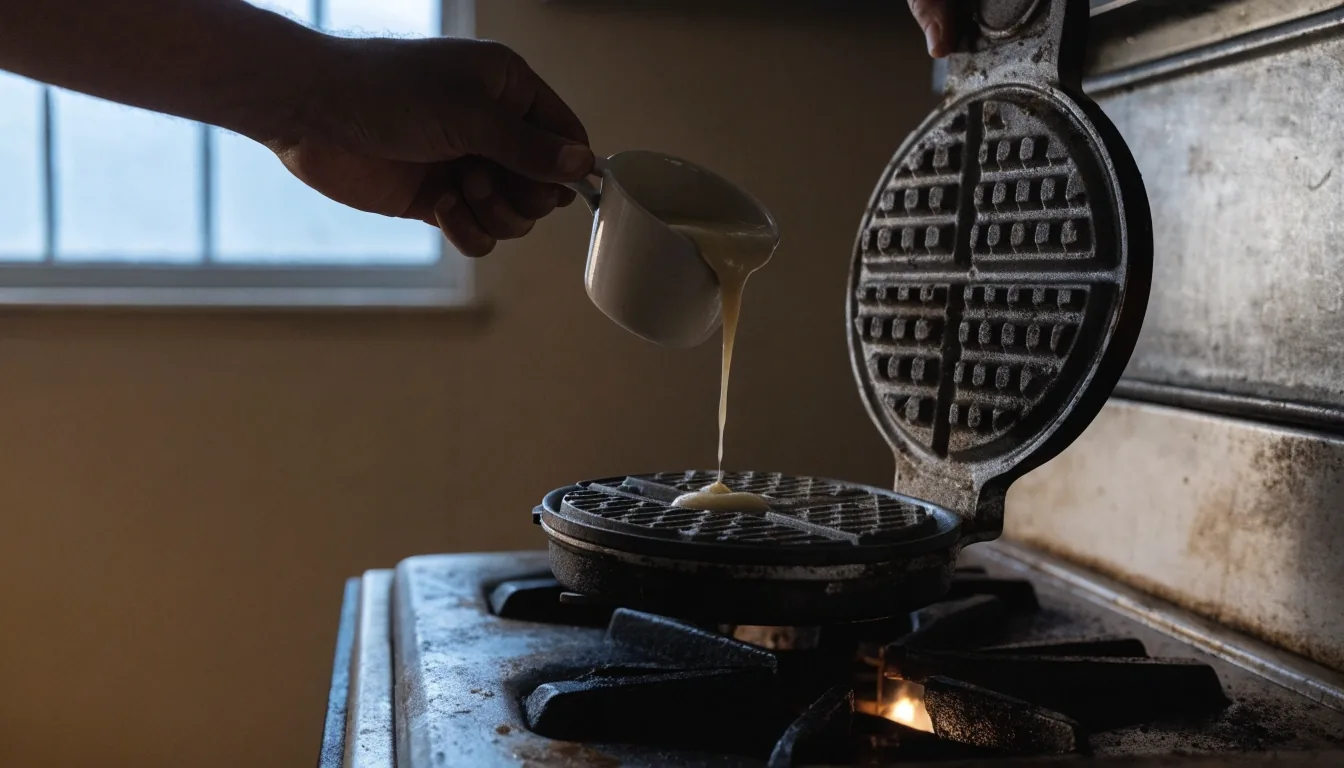
Every homemade waffle house recipe on this site goes through at least three full cooks in our Seattle kitchen before it appears. The first cook is exploratory: does the formula produce the texture we're after at all? If not, the recipe doesn't move forward — it goes back on the bench or gets dropped.
The second and third cooks happen on different days, with different irons, and with a deliberate focus on repeatability. If the results vary, we adjust the recipe, usually by tightening the liquid range or adding a doneness cue that helps a reader know what to look for in the pan.
We cook in the equipment we actually own, which means standard countertop waffle irons rather than commercial bakery equipment. That's the whole point. A recipe validated on a professional machine tells you almost nothing about your Saturday morning at home.
Once a recipe is published, it stays in rotation. We recook it periodically to check it still behaves as written — especially when an ingredient we use changes or a reader reports a problem we cannot reproduce. The waffled house recipes list here is short on purpose; every entry earns its place by passing the same bench.
Ingredients
How we think about sourcing
We write recipes with supermarket ingredients first. If a homemade waffle house recipe genuinely needs something harder to find, we say so up front and explain what it does — rather than burying it in a list and letting the reader find out at the pan.
We don't list brands. Formulas change without notice, and a reader three states away may not be able to buy the same box. What travels reliably is a description of what the ingredient needs to do in the batter.
-
Pearl sugar
The clearest example. It is not a substitute for coarse sugar, and a Liège waffle without it is not the same food. We would rather tell you that plainly than pretend the swap works.
-
Flour
We test with standard all-purpose and note alternatives only once we've cooked them. Whole wheat, bread flour, and one-to-one gluten-free blends behave differently, and each gets its own notes instead of a general reassurance that any flour works.
-
Leavening & liquid
Freshness matters more than the label. Baking powder that has sat in the cupboard a year will pull a formula short, so we describe how a batter should look as it rests rather than leaning on a shelf-life promise.
Reader reports
Handling reader corrections
The most useful messages we get describe a specific failure: what the batter looked like, what the iron was set to, how long it cooked, and what went wrong. That is enough for us to troubleshoot, and often enough to find a gap in the recipe.
A report we can act on
Batter poured like heavy cream but the pockets still collapsed on a ten-year-old iron set to medium-high, with a two-flour swap halfway through. That kind of detail lets us tell whether the fault is the recipe, the equipment, or one substitution that changed the whole batch.
A report we cannot
“It didn’t work” is hard to act on. We usually write back asking for the details above. It is not a brush-off; it is genuinely the only way to trace the problem back to a step we can fix.
When we correct a recipe
When a correction reveals a real problem, we update the recipe and note what changed at the bottom of the page. Readers who cooked from an earlier version can compare directly instead of wondering why the kilos and cups stopped matching. We don’t remove negative reports — if a recipe fails for a meaningful number of people under similar conditions, that is information, and hiding it helps no one.
- Median turnaround
- Same week
- Versions kept public
- Always
- Reports removed
- None
Limits
Where our testing has limits
We test on the irons we own, which is a small sample of what is out there. An iron with a different wattage, plate material, or heat distribution will behave differently, and no amount of recipe testing can fully close that gap.
Altitude and humidity affect waffle batter in ways a Seattle kitchen cannot measure. If you are cooking at 5,000 feet, expect the batter to want slightly less leavening and a little more liquid — and treat our timings as a starting point rather than a rule.
Ingredient variation is the third limit. Flour absorbs differently depending on the brand and the season. The same formula that pours perfectly in January may want a splash of milk in July. We try to write around these limits by giving cues instead of absolute numbers — “until the batter pours like heavy cream” works across brands and seasons, where a specific volume does not.

We would rather publish twelve tested recipes than fifty we haven’t cooked
There is a category of food blog that rewrites a recipe from another source without cooking it. The failure mode is obvious the moment you try it: the proportions don’t work, the timings are wrong, or the method skips a step that mattered. We would rather publish twelve tested recipes than fifty we haven’t touched — that’s the editorial choice this site is built on. You’ll notice the recipe list is short and the surrounding pages are long. That is deliberate.
We also don’t publish a formula just because it’s trending. If a style of waffle isn’t something we can test properly with the equipment we own, we leave it to someone who has the right iron. And when a formula simply refuses to behave, we write the page that says so and explains what went wrong — a page that admits an approach didn’t work in our kitchen is more useful than one pretending every experiment succeeded.
Questions readers send
The questions we keep fielding
- Do you accept sponsored recipes?
- No. Recipes here are developed and tested without brand partnerships, and we don’t accept payment for placement. That is a policy decision, and it is the reason the recipe list is short.
- Why did a recipe change since I last cooked it?
- Usually because reader reports revealed a step that was ambiguous or a range that was too wide. Revised recipes carry a note at the bottom explaining what changed, so you can compare it against the version you cooked.
- Can I send you a recipe to test?
- We read every message, but we can’t commit to testing everything we receive. If you include the specific problem you’re trying to solve, we’ll usually write back with an answer even when we can’t get to a full test.
- Do you test on more than one iron?
- Yes — at least two irons for every published recipe. It is a small sample, and we say so. Different wattages and plate materials behave differently, and we treat our timings as a starting point rather than a guarantee.
How to send a note we can actually act on
Tell us the iron, the setting, the batter’s appearance before it hit the plates, the time it cooked, and what the finished waffle did wrong. Add whether you substituted any flour, sugar, or leavening, since one swap can change the whole batch. Send it to SeinCaro@bertrandos.com or leave a message at +1 (839) 297-4279 during weekday hours, and we’ll reply with what we can tell.
A short list is a promise we can keep
If a formula on this site ever lets you down, tell us what happened — the iron, the setting, the batter, the time, the swap. Bean-by-bean detail is how the lists stay honest. We test in our Seattle kitchen, on countertop irons, and we say so where that limits the answer.
- Kitchen
- 6980 23rd Ave SW, Seattle, WA 98106, USA
- Write to us
- SeinCaro@bertrandos.com
- Call & hours
- +1 (839) 297-4279 Monday to Friday, 9:00 AM – 6:00 PM